

What do we mean by attitudes?
Attitudes are a set of ideas and beliefs, which we formulate about the world around us. They influence the way we define what we like and do not like and are verbalised as our opinions. We often talk about our attitudes towards other people or groups of people, as well as our attitudes to media reports of what is happening locally and globally. We develop attitudes to places and the things we use, such as food, Facebook or money. Our attitudes might predict the way we behave and be a selective force in memory and perception.
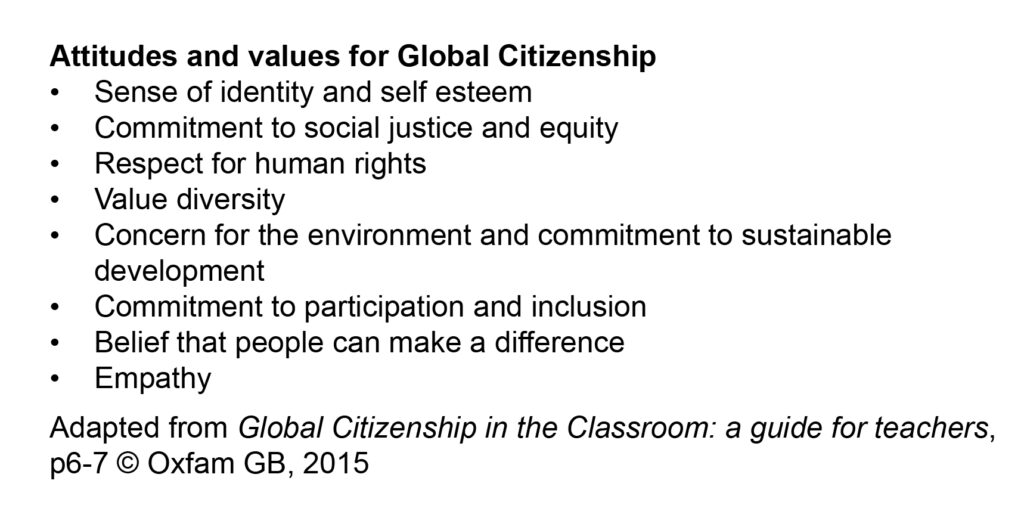
Pupils’ behaviour and actions depend on what motivates them and their attitudes are often revealed through their behaviour. For example, a child’s attitude towards the environment might be shown by their willingness to save and reuse packaging as much as possible.
While motivation is explored in teacher training, the shaping and tracking of pupils’ attitudes is often overlooked. Pupils may be motivated to act in a certain way, without a teacher understanding or questioning the attitudes underlying their behaviour. Exploring how pupils think about the world around them enables teachers to develop their understanding of pupils’ attitudes and the impact their teaching has as these attitudes develop.

How Attitudes Work
The activities in this pack are not scientific research, they are designed to give you a quick picture of what pupils think. The field of attitudinal research is widely studied and there are many different theories about how attitudes work. What we do know is that attitudes inform our behaviour and the broader and more balanced our information is, the more flexible and open our attitudes and views tend to be. Sometimes, attitudes are formed in the light of incorrect information, or a very narrow, ‘key hole’ view. Education should encourage pupils to see the world accurately and broadly, and form the best attitudes possible.
You may find this way of understanding attitudes useful:
The Cognitive component encompasses the information we receive about the real world around us; this component is, to a certain extent, subjective depending on the ability and experiences of the individual. This manifests itself in the way pupils reveal their knowledge and use it in discussions, how they support their beliefs, make decisions and substantiate them.
The Affective component is evaluative. It is based on our emotions; how we feel about certain people, situations or things. This may reveal itself, for example, during conflicts. When an issue arises that pupils feel strongly about, expression of knowledge and experiences may be influenced by emotions.
The Conative, or behavioural, component is how attitudes are revealed to others through our behaviour. It encompasses the readiness of pupils to react in a certain way in a given situation.
The cognitive component can influence the affective and conative, while the affective component often has the greatest influence on attitudes. Emotions can cause us to adjust and distort available information in a direction that is in tune with our experience. The cognitive together with the affective component impact on our behaviour and actions.
